

Luxury interior design is the deliberate balance of spatial proportion, bespoke craftsmanship, tactile materiality, and sensory atmosphere. Rather than an aggressive display of expensive furnishings, true modern luxury reflects architectural restraint, seamless functionality, and effortless lifestyle customization.
Whether designing a historic brownstone in New York, an oceanfront estate in Palm Beach, a penthouse in Chicago, or a modern pavilion in Los Angeles, achieving authentic high-end interiors requires moving past retail trends to master foundational design principles.
What Defines Luxury Interior Design Today? The "Quiet Luxury" Shift
The definition of luxury residential design has fundamentally evolved away from gaudy gilding, heavy rococo flourishes, and mass-market designer logos. Today’s premier residential standard centers on quiet luxury—an understated, curated design language focused on provenance, architectural flow, and exquisite material integrity.
Modern high-end interior decorating prioritizes how an environment feels to inhabit over how loudly it photographs. It values hand-chiseled stone over synthetic quartz composites, custom artisanal millwork over catalog furniture, and acoustic dampening over echoing cavernous voids.
The 4 Foundational Pillars of High-End Interiors
Authentic luxury interior design is built from the structural envelope inward. Four fundamental pillars separate multi-million-dollar custom architecture from basic retail staging:
-
Spatial Volume and Sightlines: High-end interiors start with proportion. Ceiling height, hallway clearance, aligned doorways (enfilade arrangements), and natural light paths dictate layout decisions before any furniture is selected.
-
Bespoke Millwork and Integrated Architectural Joinery: Built-to-order elements—such as rift-sawn white oak ceiling beams, integrated fluted-stone wet bars, recessed hidden storage, and solid-core 8-foot doors—establish structural permanence. Off-the-shelf catalog cabinets immediately break the illusion of authentic luxury interior design.
-
Acoustic & Tactile Depth: High-end living spaces are calibrated for sensory comfort. Plaster walls (such as Marmorino or Tadelakt), heavy layered draperies, wool floor coverings, and discreet acoustic insulation reduce harsh sound bouncing, creating a serene, cocooned ambiance.
-
Concealed Smart-Home Infrastructure: Modern high-end residences integrate state-of-the-art automation—motorized solar and blackout pockets, zoned architectural Lutron lighting scenes, invisible Sonance architectural speakers, and integrated HVAC returns—without visible switch clutter, wall warts, or exposed wire conduits.
High-End Interiors vs. Standard Spec-Home Commercial Builds
Investing in luxury interior decorating requires knowing the difference between heirloom-quality construction and builder-grade "luxury" marketing.
| Architectural Element | Authentic High-End Interiors | Standard Commercial / Spec-Home Build |
| Stone & Surfaces | Continuous, bookmatched natural slabs (Calacatta Viola, quartzite, travertine) | Prefabricated engineered quartz slabs with repetitive, printed artificial veining |
| Cabinetry & Millwork | Full-custom inset joinery, dovetailed solid-hardwood drawers, integrated soft-close hinges | Semi-custom stock boxes with MDF door fronts and visible edge-banding |
| Door & Cabinet Hardware | Solid forged unlacquered brass, blackened bronze, and custom knurled pulls | Lightweight, hollow die-cast zinc alloy coated in synthetic brushed nickel |
| Architectural Lighting | Trimless, deep-regressed 2700K warm-dim architectural downlights and perimeter coves | Surface-mounted wafer lights or shallow recessed cans emitting harsh 3500K–5000K light |
| Window Treatments | Custom motorized floor-to-ceiling recessed pockets with wool/linen pinch-pleat drapery | Surface-mounted rods with standard pre-hemmed 84-inch or 96-inch polyester curtain panels |
| Furniture Curation | Curated gallery pieces, vintage mid-century originals, and down-wrapped bespoke upholstery | Matching 5-piece showroom sofa-and-table sets purchased from big-box retailers |
Master Materiality: Specifying Materials for Luxury Interior Design
A high-end interior requires materials that age gracefully over decades, developing a natural patina rather than wearing out.
Natural Stone & Marble Slabs
Synthetic quartz and porcelain tile cannot replicate the mineral depth, thermal feel, and visual movement of genuine quarry-cut slabs.
-
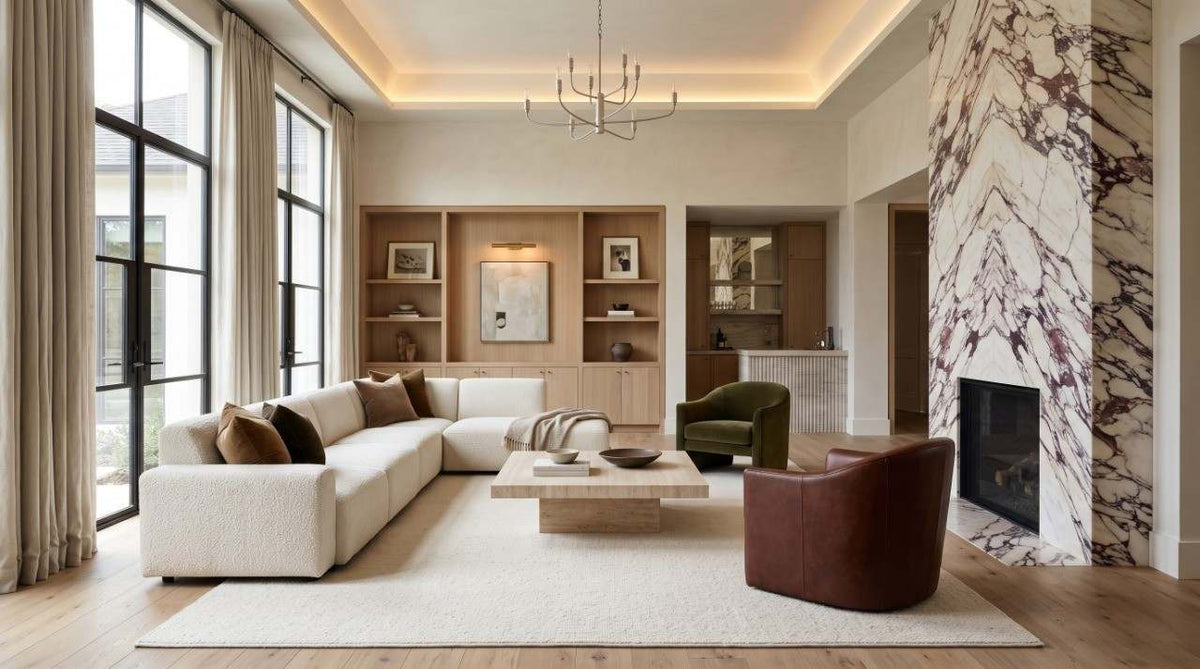
Calacatta Viola & Breccia Capraia: Characterized by dramatic, wine-colored or violet veining; ideal for waterfall kitchen islands, powder room vanity consoles, and integrated fireplace mantels.
-
Roman Travertine & Honed Limestone: Soft, matte, and deeply textural; perfect for flooring transitions, bath surrounds, and architectural columns in coastal or desert architecture.
-
Taj Mahal Quartzite: Provides the creamy warmth of marble with the scratch-and-acid resistance of granite, making it the preferred choice for heavy-use culinary kitchens.
Architectural Millwork & Flooring
Flooring and paneling create the background against which everything else is viewed.
-
Wide-Plank Engineered French Oak: 8- to 10-inch planks featuring custom reactive stains, wire-brushed finishes, and ultra-matte protective oils.
-
Chevron & Herringbone Parquetry: Adds historical gravitas and directional energy to formal foyers, grand corridors, and formal dining rooms.
-
Architectural Veneers: Bookmatched American walnut, quarter-sawn white oak, and smoked eucalyptus applied to bespoke wall paneling and floor-to-ceiling media units.
Living Metals
Avoid flat powder-coated finishes. Luxury interior decorating embraces unsealed, living metals that evolve over time:
-
Unlacquered Brass: Develops deep, organic variations with handle contact and natural oxidation.
-
Blackened Steel & Patinated Bronze: Provides sharp, industrial contrast in modern stair rails, fire screens, and structural interior glass partitions.
Bespoke Textiles
Tactile soft goods balance the cold rigidity of stone and architectural plaster:
-
Belgian Linens: Unpressed, heavy-weight drapery panels that pool gently on floorboards.
-
Mohair, Bouclé, & Alpaca: Deep-pile upholstery for sculptural lounge chairs and banquettes.
-
Pure Vegetable-Tanned & Full-Grain Aniline Leathers: Retain unique surface markings and soften naturally over time.
Architectural Lighting: How to Create High-End Interiors with Depth
Lighting makes or breaks high-end interior design. Luxury spaces never rely on a single centered ceiling fixture or harsh overhead glare. Instead, professional designers balance three distinct, dedicated circuits—all wired to smart automation modules and calibrated to a warm 2700K (or 2400K–1800K warm-dim spectrum) with a high Color Rendering Index (95+ CRI).
| Lighting Tier | Architectural Role | Ideal Fixture Types | Placement & Control Strategy |
| 1. Ambient Tier (Foundation) | Establishes soft, overall room illumination without visible hotspots or harsh shadows. |
• Trimless deep-regressed downlights
• Concealed architectural ceiling cove LEDs
• Perimeter plaster wall washers
|
Recessed flush into ceiling drywall; wired to multi-scene astronomical timers that transition from day to evening. |
| 2. Task Tier (Function) | Delivers targeted, shadow-free illumination precisely where daily activities take place. |
• Integrated under-cabinet linear fixtures
• Directional bedside reading sconces
• Kitchen island and vanity prep spotlights
|
Angled directly toward work planes; controlled via individual local switches or zone-specific keypad scenes. |
| 3. Accent Tier (Drama & Focus) | Draws the eye to architectural textures, focal points, and curated fine art investments. |
• Low-voltage micro picture projectors
• In-floor graze uplighting for columns
• Sculptural artisan chandeliers & pendants
|
Set to 30% higher intensity than surrounding ambient wash to create visual hierarchy and dimensional contrast. |
How to Layer These Circuits for True Luxury
-
Eliminate Ceiling Clutter ("The Swiss Cheese Effect"): Avoid haphazard grids of generic wafer cans. Group high-performance, small-aperture (1 to 2-inch) pinhole lights exclusively where surfaces or art need illumination, leaving open negative space across the ceiling plane.
-
Integrate Warm-Dim Dynamic Tuning: Specify fixtures that shift from a crisp 2700K daytime glow down to an intimate, candlelit 1800K as levels lower, maintaining rich textile tones rather than turning flat and gray.
-
Hide the Light Source (Reveal Only the Effect): High-end execution conceals light engines behind ceiling drops, within bespoke joinery reveals, or inside architectural millwork so occupants experience warm, ambient radiance without looking directly into raw diodes.
Regional US Adaptations for High-End Living Spaces
Luxury interior design must converse directly with its geographic location, climate, and architectural envelope.
Coastal California (Malibu, Montecito, Newport Beach)
-
Aesthetic: Warm organic minimalism, indoor-outdoor fluidity.
-
Palette: Bleached bone, warm sand, soft sage, ocean slate, and matte chalk.
-
Finishes: Honed limestone, wire-brushed white oak, textured linen drapery, and multi-slide structural glass walls opening to oceanfront loggias.
Urban Historic & Brownstone (New York City, Boston, Chicago)
-
Aesthetic: Tailored historic preservation blended with contemporary minimalism.
-
Palette: Deep espresso, charcoal, rich ochre, muted taupe, and creamy alabaster.
-
Finishes: Custom decorative crown moldings, original restored herringbone floors, reeded glass partitions, antiqued mirror backsplashes, and blackened steel hardware.
Sunbelt & Desert Modern (Scottsdale, Paradise Valley, Austin)
-
Aesthetic: Earthy, monolithic, sculptural desert sanctuary.
-
Palette: Terracotta, canyon clay, warm travertine, burnished bronze, and cactus greens.
-
Finishes: Hand-applied Tadelakt lime plaster, rammed-earth feature walls, leather-finished quartzites, and structural blackened steel overhangs that soften desert sunlight.
Southern & Coastal Southeast (Palm Beach, Miami, Charleston)
-
Aesthetic: Airy, classical resort elegance with tropical scale.
-
Palette: Crisp ivory, light coral accents, watery celadon, and polished shell tones.
-
Finishes: Polished terrazzo, natural rattan accents, high-gloss lacquered millwork, and impact-rated custom louvered shutters.
Common Mistakes That Cheapen High-End Interiors
Even with an unlimited budget, spaces can look cluttered and uninspired if classic mistakes occur:
-
Buying Matched Furniture Sets: Sourcing an entire living room or bedroom from a single catalog or showroom floor strips the space of personality, making it look like a commercial department store rather than a curated private home.
-
Ignoring Proper Scale and Negative Space: Cramming too many furniture pieces into a grand room makes it feel cluttered. Conversely, placing an undersized 8x10 area rug in a grand 25x30 living room fragments the space. Area rugs must anchor all furniture feet comfortably.
-
Choosing Cool-Temperature Bulbs (4000K–5000K): High-Kelvin, daylight-simulating LEDs make luxury textures look synthetic, reveal minor drywall textures, and eliminate evening warmth.
-
Displaying Mass-Market "Filler" Art: Covering grand walls with mass-produced printed canvases or decorative plastic mirrors undermines premium millwork. High-end walls demand investment-grade original art, museum-framed architectural photography, or sculptural artisan commissions.
-
Exposing Smart Home Clutter: Leaving multiple light switches, thermostat modules, alarm keypads, and visible speaker grilles exposed across a single wall creates visual chaos. Luxury projects group controls into consolidated, custom-engraved keypads.
Frequently Asked Questions About Luxury Interior Design
What is luxury interior design?
Luxury interior design is the professional practice of curating high-end residential spaces using bespoke architectural millwork, premium natural materials, cohesive spatial proportions, and integrated atmospheric lighting to create an elevated, tailored living experience.
What actually makes an interior design look expensive and high-end?
True luxury is defined by custom-fabricated elements, natural material integrity, and proportional spatial balance. It relies on architectural scale, bespoke joinery, heavy natural stone, and layered 2700K lighting rather than decorative logos or gilded accents.
What is the "quiet luxury" interior decorating style?
Quiet luxury is the interior design philosophy prioritizing understated elegance, artisan craftsmanship, and long-lasting materials. It replaces loud, trendy, and logo-heavy decor with monochromatic color palettes, rich tactile fabrics (cashmere, mohair, linen), and hand-finished architectural surfaces.
How do luxury designers select color palettes for high-end homes?
Luxury designers rarely use saturated, primary wall colors. They build tonal palettes using organic neutrals—such as chalk, warm greige, alabaster, taupe, and wet stone—layered with depth through varied sheens, lime plasters, textural fabrics, and contrasting natural wood tones.
How can I make my home look luxurious on a renovation budget?
Replace builder-grade hollow-core doors with heavy, solid-core doors; install unlacquered brass or solid-bronze hardware; swap out cold 4000K ceiling bulbs for 2700K warm-dim LEDs; hang custom, ceiling-recessed linen drapery panels; and replace synthetic area rugs with properly scaled, pure wool options.
What is the best lighting color temperature for high-end interiors?
The standard for luxury homes is 2700K warm white. For dining rooms, primary bedrooms, and formal lounges, designers frequently specify warm-dim systems that slide from 2700K down to a candlelit 1800K as fixtures dim.