
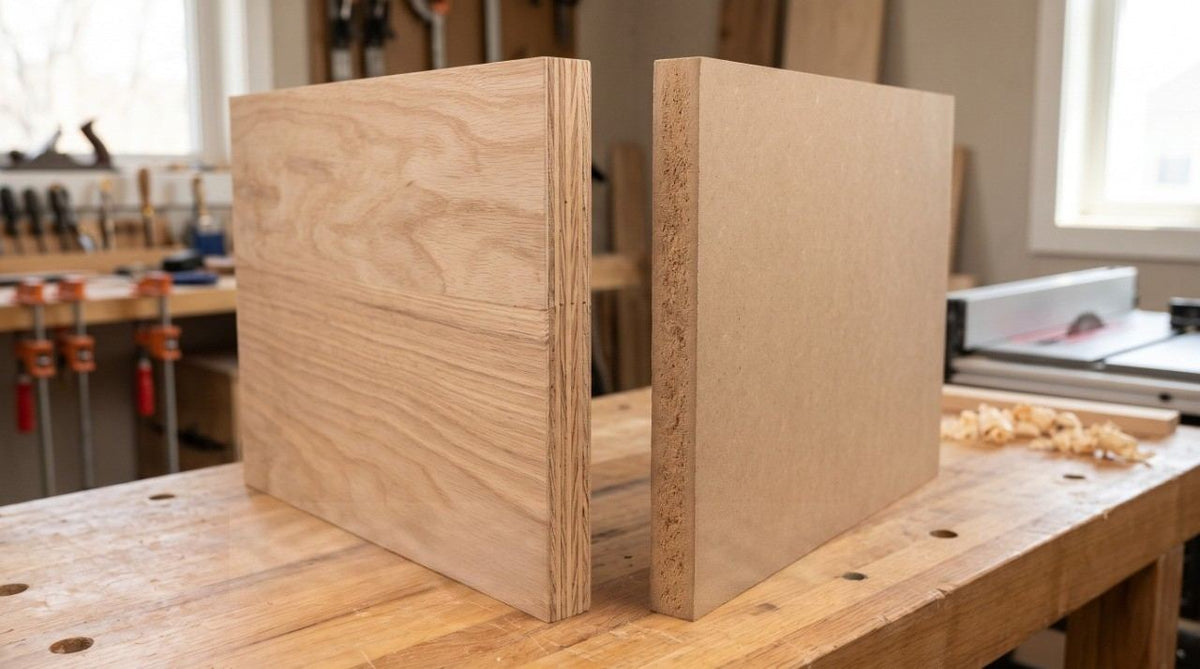

At a Glance: MDF vs. Plywood Comparison
| Performance Metric | Cabinet-Grade Hardwood Plywood | Medium-Density Fiberboard (MDF) | Application Winner |
| Primary Composition | Cross-laminated hardwood veneers bonded under heat | Dense wood fibers mixed with synthetic wax and resin | Tie (Application-dependent) |
| Structural Span Limit | High tensile strength; resists long-term shelf sag | Lower bending stiffness; sags across spans over 28" | Plywood |
| Moisture Resistance | Handles ambient humidity; exterior/marine grades resist rot | Hydrophilic core; swells permanently along unsealed cuts | Plywood |
| Paint & Enamel Profile | Requires pore fillers; grain telegraphs through finish | Ultra-smooth flat surface; ideal for sprayed lacquer | MDF |
| Screw Holding (Face & Edge) | Deep pilot bite; handles repeated hinge swing cycles | Poor edge-grain holding; prone to splitting and blowout | Plywood |
| Machinability (CNC / Routing) | Can splinter without zero-clearance table saw inserts | Cuts clean without tear-out; crisp decorative profiles | MDF |
| Average Cost (3/4" 4x8 Sheet) | $65 – $120+ (Hardwood / Baltic Birch) | $34 – $48 (Standard 49" x 97" Panel) | MDF |
| Weight per 3/4" Panel | ~60 – 68 lbs per 4x8 sheet (easier handling) | ~90 – 98 lbs per 4x8 sheet (heavy and brittle) | Plywood |
| Indoor Air Quality Standard | EPA TSCA Title VI / CARB Phase 2 compliant | EPA TSCA Title VI compliant (requires edge sealing) | Plywood |
1. What Is Plywood? Grain Structure, Grades, and Engineering
Cross-Grained Ply Architecture
| Layer Sequence | Component Role | Grain Orientation | Core Structural Purpose |
| Layer 1 (Top) | Face Veneer | East-West (Longitudinal) | Clear stain-grade surface (Grade A/B finish) |
| Layer 2 | Cross-Core Ply | North-South (Transverse) | Locks width expansion; stops lateral cupping |
| Layer 3 (Center) | Center Core | East-West (Longitudinal) | Neutral axis; absorbs central shearing stress |
| Layer 4 | Cross-Core Ply | North-South (Transverse) | Balances tensile pull across lower veneer |
| Layer 5 (Bottom) | Back Veneer | East-West (Longitudinal) | Balances board face; seals tension plane |
Key Engineering Advantages of Plywood
-
Multi-Directional Strength: Because natural timber expands and contracts across its grain rather than its length, cross-graining mechanically locks adjacent plies against each other, eliminating board twist, cup, and bow.
-
Superior Fastener Holding: Threads cut into alternating plies, locking screws in place from both radial and longitudinal angles.
-
High Strength-to-Weight Ratio: Plywood delivers roughly twice the tensile strength of MDF at two-thirds the total weight per square foot.
-
Standard US Core Types:
-
Veneer Core (VC): Alternating softwood or hardwood plies throughout; standard for kitchen carcasses.
-
MDF Crossband Core (Classic Core): Plywood inner plies with thin outer MDF skins for flat painting without veneer telegraphing.
-
Baltic Birch (Multi-Ply): Void-free solid birch throughout with zero internal overlaps or gaps.
-
2. What Is MDF? Fiber Density, Resins, and Machining
Key Material Characteristics of MDF
-
Isotropic Structure: MDF has no grain pattern, growth rings, knots, or voids. Its density remains uniform across every square inch of the board.
-
Flawless Finish Base: Because it lacks natural open grain pores, MDF requires no grain filling. Solvent-borne lacquers, conversion varnishes, and enamel paints cure to a flat, mirror-grade sheen.
-
Exceptional Edge Profiling: Router bits cut through MDF cleanly without grain tear-out, making it the industry benchmark for CNC-routed door panels and wainscoting.
-
Critical Drawbacks:
-
Highly prone to edge splitting if pilot holes are skipped.
-
Releases fine airborne particulate dust during cutting that requires dedicated vacuum extraction and N95 respiratory protection.
-
Heavy panels make solo delivery and overhead installation difficult.
-
3. Structural Comparison: Load Capacity, Screws & Moisture
Span Deflection Under 30+ lbs Static Load (The Sag Test)
| Shelf Material (3/4" Board) | Max Unsupported Span | Deflection under 30 lbs/sq.ft. | 2-Year Sag Outcome |
| Cabinet Hardwood Plywood | 32 to 36 inches | Minimal deflection (under 1/32") | Remains visually level; elastic recovery holds |
| Baltic Birch Multi-Ply | 36 to 42 inches | Negligible deflection | Zero long-term permanent deflection |
| Standard Raw MDF | 24 to 28 inches | Measurable deflection (~1/8" to 3/16") | Permanent downward curve (viscoelastic creep) |
-
The Physics of "Creep": Under sustained static weight (such as rows of hardcovers or heavy kitchen dishware), the synthetic resins in MDF undergo slow plastic deformation. While plywood bounces back when load is cleared, MDF retains a permanent bend.
-
Fixing the MDF Sag: If MDF shelves exceed 26 inches, you must reinforce the front face with a solid 1" x 1.5" hardwood edge band or underside stiffener batten.
Fastener Retention & Hinge Failure Points
-
Face Screwing: Both materials hold face-driven screws securely when driven at 90 degrees.
-
Edge Screwing:
-
Plywood: Threads mechanically bite through alternating veneer grains without splitting out, even with standard #8 woodworking screws.
-
MDF: The edge operates like stacked cardboard. Driving a standard wood screw forces the fiber layers apart like a wedge, blowing out the edge. You must pre-drill pilot holes 1/16" larger than the screw root and use straight-shank Confirmat or Euro-style hinge screws.
-
-
Repeated Fastener Cycling: Cabinet doors opened thousands of times will work hinge screws loose. Stripped screws in plywood can be filled with wood glue and dowel plugs; stripped holes in MDF typically require filling with two-part epoxy or drilling out for plastic threaded expansion inserts.
Water Exposure Mechanics: Swelling and Recovery
-
Capillary Action in MDF: Raw MDF edges draw standing water up into the board interior like a wick. This causes unsealed fibers to break free from the resin matrix and expand up to 30% in thickness. Once dried, MDF will not return to its original shape or strength.
-
Dimensional Memory in Plywood: While extended soaking can cause face veneer discoloration or glue-line delamination in cheap boards, exterior-grade and cabinet-grade plywood dry out and retain nearly all of their original core thickness and flat profile.
4. US Material Pricing Breakdown (2026 Estimates)
| Sheet Material (4' x 8' Standard) | Actual Thickness | Average US Price Range | Best Practical Application |
| Standard Industrial MDF | 1/2" (12.7mm) | $24 – $32 | Wall paneling, drawer bottoms, wainscoting |
| Standard Industrial MDF | 3/4" (19mm) | $34 – $48 | Cabinet doors, painted face trim, jambs |
| Moisture-Resistant (MR) Green MDF | 3/4" (19mm) | $52 – $68 | Bathroom vanities, laundry rooms, sills |
| Sanded BCX Pine Plywood | 3/4" (23/32") | $42 – $55 | Utility workbenches, subfloors, storage bins |
| Pre-Finished Maple Hardwood Plywood | 3/4" (23/32") | $68 – $95 | Kitchen cabinet carcasses, open shelving |
| Baltic Birch Import (13-Ply Core) | 3/4" (18mm) | $95 – $140 | Dovetail drawer boxes, heavy shop jigs |
5. Room-by-Room Decision Matrix: Which Material Goes Where?
The Hybrid Cabinet Specification Strategy
| Cabinet Component | Recommended Core Material | Why This Material Wins the Job |
| Carcass & Outer Box | 3/4" Plywood (Pre-Finished) | High screw-holding power; supports heavy countertops; zero water swelling |
| Shelves (Spans > 28") | 3/4" Plywood | Carries heavy dish stacks and cookware without long-term sagging |
| Drawer Boxes | 1/2" or 5/8" Baltic Birch | Holds tight dovetail joint pins; withstands daily pull impact |
| Drawer Bottoms | 1/4" Plywood or 1/4" MDF | High rigidity in captured dado grooves without bottom sagging |
| Painted Door Panels | 3/4" MDF or MR MDF | Zero seasonal joint expansion; stops paint cracking at stile/rail joints |
| Decorative Wall Moulding | 1/2" or 3/4" MDF | Routable edges; smooth primer adhesion; no visible open grain pores |
Room-Specific Installation Guidelines
-
Kitchens & Pantries:
-
Under-Sink Base Units: Plywood is mandatory. Slow plumbing leaks around disposal units or P-traps will ruin MDF cabinet bases.
-
Pantry Pull-Outs: Plywood side panels anchor heavy-duty 100-lb drawer slides securely without stripping out under weight.
-
-
Bathrooms & Powder Rooms:
-
Vanity Carcasses: Use cabinet-grade plywood or specialized MR (Moisture-Resistant) green-core MDF.
-
Wall Shiplap & Wainscoting: Standard MDF can be used safely if all end cuts, back faces, and baseboard junctions are sealed with an oil- or shellac-based primer before installation.
-
-
Home Offices & Built-in Libraries:
-
Bookcases: Plywood is strongly recommended. If using MDF for cost reasons, keep shelf spans under 24 inches or face the shelf fronts with a solid 1x2 timber lip.
-
Desk Tops & Workstations: MDF provides a smooth writing and mouse surface, but requires support ribs every 24 inches to prevent sagging under monitor mounts.
-
6. US Climate & Regional Considerations
| US Climate Zone | Key Regional Environmental Challenge | Recommended Sheet Good Specification |
| Southeast & Gulf Coast (FL, LA, TX) | High ambient humidity; high heat; coastal moisture risks | Use Cabinet-Grade Plywood for all casework; avoid unsealed standard MDF; use MR-grade MDF for doors |
| Midwest & Northeast (IL, NY, MA) | Extreme seasonal swings: dry winter heating (20% RH) to humid summers (75% RH) | Use MDF for painted door panels to eliminate seasonal hairline paint joint cracks; use Plywood for boxes |
| Southwest & Desert (AZ, NV, SoCal) | Extremely arid year-round; low relative humidity | MDF performs well without moisture expansion; beware low-grade plywood drying out and checking |
| Pacific Northwest (WA, OR) | Sustained, cool damp weather throughout winter and spring | Use water-resistant plywood adhesives; ensure full primer sealing on all MDF edge profiles |
7. What About Modern Alternatives? (HDF, HDHMR, and Particle Board)
-
HDF (High-Density Fiberboard): Compressed beyond 55 lbs/cu.ft. It offers extreme hardness, making it ideal as the backing core for laminate flooring, but is too heavy and dense for standard residential casework.
-
HDHMR (High-Density High-Moisture Resistance): An engineered board using polyurethane resins common in Asian and European fabrication. In the US, the direct equivalent is Moisture-Resistant (MR) MDF, identified on lumberyard racks by its solid green-tinted core.
-
Industrial Particle Board (PB / Mela-Core): Made from coarse wood chips bonded with resin. While budget-friendly, it lacks the routing detail of MDF and has low fastener grip. It is best reserved for budget utility storage lined with pre-glued melamine skins.
8. Frequently Asked Questions (FAQ)
Can I paint plywood to look as smooth as MDF?
What is the best way to prevent MDF edges from splitting?
Is MDF safe for indoor air quality in residential homes?
Can you use MDF in a bathroom setting?
Which material is better for floating shelves: Plywood or MDF?
Continue Learning: Related Interior & Furniture Guides
Looking to elevate your living spaces or plan your next home upgrade? Explore these in-depth guides on furniture sizing, woven materials, and high-end design:
-
How to Choose a Dining Table: The Complete Buyer’s Guide (With Sizing & Material Chart)
Master the 36-to-42-inch clearance rule, calculate exact seating capacities, and compare solid hardwood, sintered stone, and veneer durability.
-
What is Wicker Furniture? Materials, Types, Durability, and Buying Guide
Understand the difference between natural organic weave and all-weather synthetic HDPE resin, plus real-world maintenance tips.
-
What Is Luxury Interior Design? A Guide to Creating High-End Interiors
Learn how to blend architectural proportions, bespoke furniture pieces, and artisanal textures to craft sophisticated living spaces.